NSA Utah and the Massive Surveillance Grid Hiding in Plain Sight
By Tracy Brinkmann
Behind high-security fences and nondescript concrete walls, a nationwide construction boom is quietly reshaping the American landscape. The public narrative says these facilities are simply building blocks for cloud hosting and artificial intelligence. However, an analysis of intelligence precedents and modern surveillance infrastructure shows that these data centers also represent one of the most powerful surveillance apparatuses ever created.
This deep dive uncovers the intersection of AI investment, surveillance laws like FISA Section 702, physical intelligence risks, and the colossal strain on national power and water grids.
Key Takeaways
-
The Stargate Buildout: U.S. data center spending surged 331% between 2021 and 2025, culminating in multi-hundred-billion-dollar initiatives like the White House-backed Stargate Project.
-
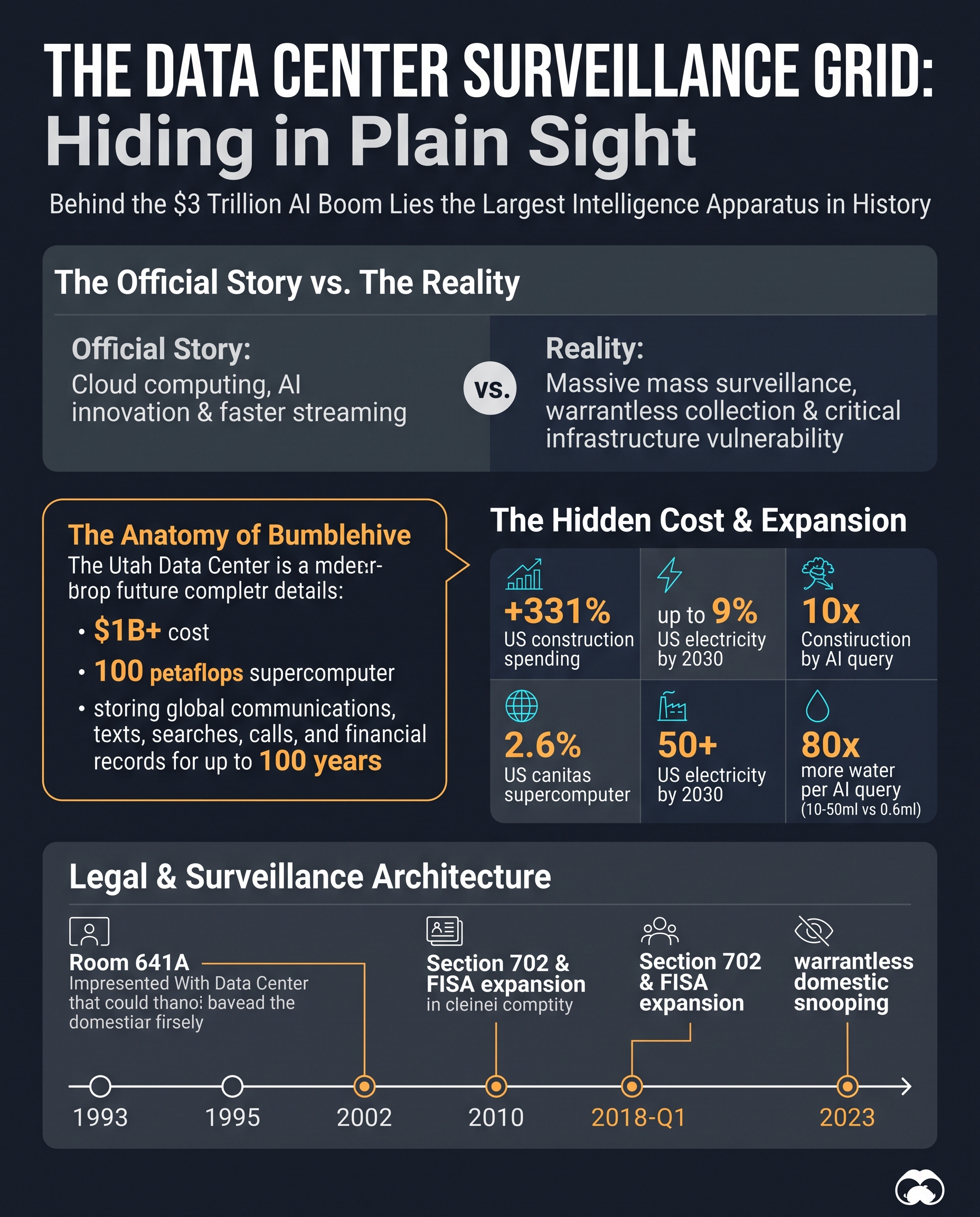
The NSA’s Utah Flagship: Codenamed "Bumblehive," the $1B+ facility in Bluffdale, Utah, houses over 100 petaflops of supercomputing power to process and store text messages, search queries, financial records, and medical data.
-
Expanding Legal Authority: Under the 2024 Reforming Intelligence and Securing America Act (RISAA), anyone with physical access to digital infrastructure—including maintenance crews and landlords—can be legally compelled to assist in Section 702 surveillance.
-
Environmental Demands: Data centers could consume up to 9% of total U.S. electricity generation by 2030, with single AI queries consuming up to 80 times more water for cooling than traditional web searches.
-
Physical Espionage Concerns: Shared hosting environments and foreign-backed facilities—such as a Chinese-owned crypto mine shut down near F.E. Warren Air Force Base—highlight critical physical access vulnerabilities.
1. The Utah Data Center: Inside the Government's "Darknet"
To understand modern data infrastructure, one must look at the blueprint established in the Utah desert. Formally named the Utah Data Center and codenamed Bumblehive, the facility sits near the Point of the Mountain in Bluffdale. Built at a cost exceeding $1 billion, it spans over 1 million square feet and requires 60 diesel standby generators to maintain continuous operation.
+--------------------------------------------------------------+
|                     NSA BUMBLEHIVE METRICS                   |
+--------------------------------------------------------------+
| Scale:             1,000,000+ sq. ft.                        |
| Supercomputing:    Cray XC30 handling 100+ Petaflops         |
| Power & Cooling:   $40M annually in electricity alone        |
| Power Redundancy:  60 backup diesel generators (3-day backup)|
| Scope of Storage:  Text messages, phone calls, web history,   |
|                    financial records, travel & health data   |
+--------------------------------------------------------------+
Former NSA executive and whistleblower Thomas Drake described the facility not merely as a storage center, but as "the government's darknet," pointing to a system aimed at collecting communications on a global scale. Co-designer of the ThinThread program William Binney previously noted that the capacity of the facility was designed to allow storage of communications sent and received worldwide for up to 100 years.
Decades before modern hyperscalers, this mass collection philosophy superseded privacy-first designs:
-
The Rejection of ThinThread: ThinThread possessed automated built-in filters to strip out domestic American records, but it was passed over in favor of broad collection programs.
-
Room 641A: As early as 2003, AT&T's San Francisco switching center housed specialized hardware intercepting raw internet backbone traffic via optical splitters.
-
Prism and Upstream: Documented by Edward Snowden in 2013, these twin collection pillars granted intelligence agencies warrantless access to user data from leading web platforms and subsea fiber lines.
2. Expanding Legal Authorities: From Section 702 to RISAA
While federal courts ruled in September 2020 that original bulk phone-record collection programs were unlawful, legislative authorities have steadily broadened rather than contracted.
The Reforming Intelligence and Securing America Act (2024)
In April 2024, Congress reauthorized Section 702 of FISA under the Reforming Intelligence and Securing America Act. Rather than curbing overreach, the statutory definition of an electronic communication service provider was expanded. The revised text enables the federal government to compel anyone with physical access to equipment—from commercial building owners to on-site technicians and cleaning staff—to assist in surveillance execution under strict nondisclosure rules.
Documented Compliance Breaches
Despite statutory boundaries restricting Section 702 to non-U.S. persons located abroad, misuse persists:
-
In August 2024, Justice Department overseers revealed that the FBI utilized querying systems without adhering to required privacy safeguards.
-
Warrantless queries had been run against international communications involving domestic journalists, political figures, civil demonstrators, and roughly 19,000 contributors to a single political campaign.
-
Although the Senate failed to clear a Section 702 procedural vote (47–52) on June 5, 2026, existing FISA certifications signed earlier that spring permit collection operations to legally proceed through March 2027 regardless of congressional deadlocks.
3. The Resource Strain: Water Grids and Power Surges
Modern data center deployment creates severe strain on regional public utilities, as AI computation requires unprecedented amounts of electricity and cooling resources.
      Electricity & Water Consumption Comparisons
+-----------------------------------------------------------+
| Electricity: 2025 vs. 2030 Projections                   |
| 2025: ~4% of total U.S. electric generation               |
| 2030: Projected up to 9% (EPRI Estimate)                  |
+-----------------------------------------------------------+
| Water Consumption Per Digital Query                       |
| Traditional Google Search: ~0.6 ml                        |
| Single Generative AI Query: 10 - 50 ml (Up to 80x increase)|
+-----------------------------------------------------------+
-
Power Surges: Data centers currently account for roughly 4% of U.S. power demand. Projections from Goldman Sachs and the Electric Power Research Institute (EPRI) indicate this demand could expand to 9% of all domestic electricity output by 2030.
-
Aquifer Usage: In Texas alone, water consumption dedicated to facility cooling reached an estimated 49 billion gallons in 2025, with models scaling to 399 billion gallons as regional buildouts expand.
-
Per-Transaction Water Footprint: Liquid cooling requirements mean a basic generative text query requires between 10 and 50 milliliters of water, contrasting sharply with the 0.6 milliliters consumed by a typical internet search.
4. Foreign Proximity Risks and Physical Vulnerabilities
The physical infrastructure housing sensitive government and commercial databases presents tangible national security vulnerabilities.
The Francis E. Warren AFB Incident
In June 2022, Chinese-backed Mine One Partners (tied to former pork distributor Bit Origin) set up a high-density crypto operation within a mile of Wyoming’s Francis E. Warren Air Force Base—a strategic base managing Minuteman III intercontinental ballistic missiles.
Microsoft, operating an adjacent Department of Defense data installation, flagged the facility to the Committee on Foreign Investment in the United States (CFIUS), warning that specialized foreign hardware placed directly alongside missile control networks posed serious electronic intercept risks. In May 2024, the White House ordered the immediate shutdown and liquidation of the site.
The Vulnerability of Shared Tenant Spaces
While standalone installations near sensitive targets face scrutiny, legal analysts have highlighted vulnerabilities within domestic multitenant commercial facilities:
-
Domestic and foreign commercial enterprises routinely share space, power, and rack containment in the same server buildings.
-
Direct physical proximity bypasses remote firewalls; malicious hardware or physical tapping devices can be placed inside shared enclosures without triggering network detection systems.
-
Key electrical and operational components—including high-voltage transformers, backup battery arrays, and optical transceivers—continue to be procured from overseas supply chains in strategic adversary nations.
5. Public Pushback and Political Retaliation
Citizen resistance has rapidly emerged as facilities cluster around critical infrastructure. Northern Virginia alone hosts approximately 300 data centers, processing nearly two-thirds of all global internet traffic.
-
Local Activism: Across 24 states, roughly 142 distinct activist coalitions have mobilized against proposed centers, leading to the delay or cancellation of $64 billion worth of capital projects between May 2024 and March 2025.
-
Public Opinion: Nationwide polling by Gallup revealed that 71% of surveyed Americans somewhat or strongly oppose the construction of commercial data centers in their immediate neighborhoods.
-
The "Foreign Influence" Label: Instead of directly resolving core environmental and power rate grievances, political leaders have frequently dismissed pushback as foreign psychological operations. For instance, public claims emerged alleging that Chinese influence networks orchestrated the domestic anti-data center movement, an assertion that independent analysts warn sidesteps legitimate civil concerns about power costs, local water tables, and physical surveillance footprints.
Frequently Asked Questions (FAQ)
What is the NSA Utah Data Center?
The NSA Utah Data Center (codenamed "Bumblehive") is a large-scale data storage and processing facility in Bluffdale, Utah. Spanning over one million square feet, it utilizes high-performance supercomputing to process, index, and store massive amounts of global internet traffic, text communications, and digital metadata.
How does FISA Section 702 impact commercial data centers?
Under the Reforming Intelligence and Securing America Act (RISAA) reauthorization, Section 702 expands the legal definition of service providers. This modification grants federal agencies the legal authority to compel building owners, facility technicians, and maintenance staff who have physical access to network infrastructure to aid in surveillance activities.
Why do AI data centers require so much water?
Data centers deploy high-density server configurations running demanding compute loads that generate intense heat. Evaporative cooling systems rely on substantial volumes of water to cool server racks, using anywhere from 10 to 50 milliliters of water for a single complex AI text query.
Can Section 702 surveillance continue if Congress lets it expire?
Yes. Intelligence collection can continue beyond legislative expiration dates because the Foreign Intelligence Surveillance Court (FISC) grants multi-month certifications. For example, FISC certifications granted in early 2026 ensure lawful surveillance authorities can extend through early 2027 even if congressional renewal votes fail.
The Path Forward
The rapid construction of modern data infrastructure cannot be evaluated purely through the lens of enterprise cloud expansion or artificial intelligence productivity. These installations exist at the intersection of intelligence gathering, civil privacy law, national security, and public infrastructure strain.
Understanding how surveillance statutes interact with domestic hardware is critical for navigating the modern digital landscape.
For an in-depth breakdown of these developments and source investigations, watch the complete report by