Who Owns the Media? Why Networks Won't Report It
TL;DR:
Mainstream news networks rarely scrutinize corporate power because six conglomerates control roughly 90% of American media outlets. Through cross-ownership conflicts, board-level entanglements, multi-billion-dollar advertiser relationships, and decades of bipartisan deregulation, news networks operate within strict structural incentives. As a result, editorial priorities naturally protect parent company bottom lines rather than public accountability.
[by Tracy Brinkmann]
Why Mainstream Media Won’t Question Ownership: The Structural Architecture of Modern News
When the evening broadcast begins, news anchors address politics, conflict, and consumer trends, but one fundamental question remains conspicuously absent: who signs their paychecks? This silence is neither an accident nor an oversight; it is an inherent feature of corporate media architecture.
Below, we break down why news networks cannot structurally challenge their parent companies, how decades of deregulation enabled unprecedented consolidation, and how advertising revenue dictates the boundaries of permissible debate.
Key Takeaways
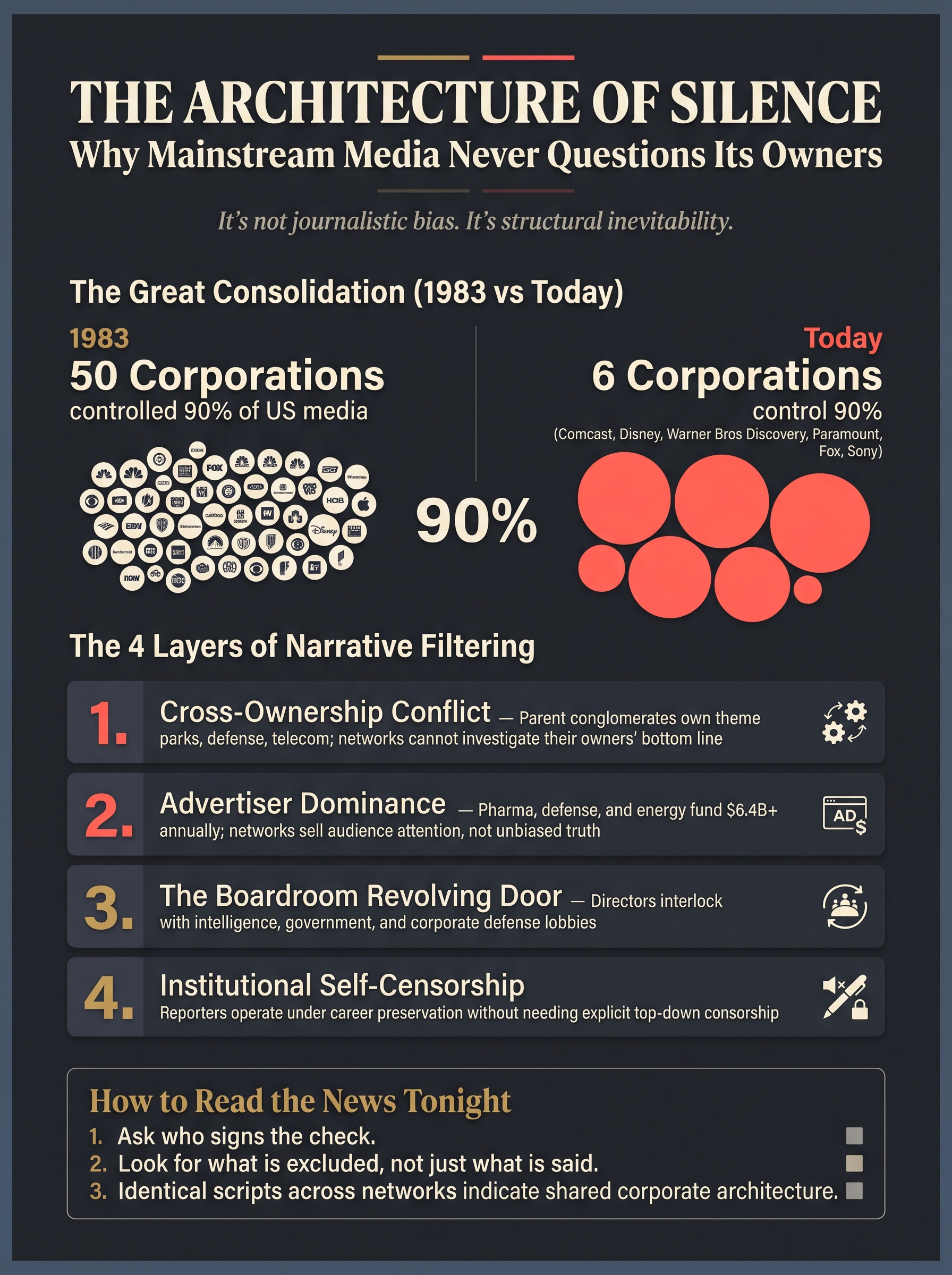
Radical Consolidation: Control of approximately 90% of American media has contracted from 50 corporations in 1983 down to just six major conglomerates today.
Cross-Ownership Conflicts: When a conglomerate owns both news platforms and outside commercial assets (theme parks, defense investments, studios), investigative reporting into those commercial interests poses an existential corporate conflict.
The Advertising Filter: Billions of dollars in annual broadcast ad spend—led by pharmaceutical companies, defense contractors, and energy giants—embed direct corporate relationships that shield sponsors from rigorous scrutiny.
Bipartisan Deregulation: The decline of media diversity stems from decades of policy shifts across multiple administrations, starting with the repeal of the Fairness Doctrine in the 1980s through the Telecommunications Act of 1996 and subsequent ownership rule relaxations.
Incentive Over Direct Censorship: Rather than issuing daily censorship orders, media organizations rely on corporate incentive structures, editorial hiring practices, and career preservation to suppress counter-narratives.
From Fifty to Six: The Consolidation of American Media
To understand modern news framing, one must examine the rapid concentration of media property over the last forty years. In 1983, media scholar Ben Bagdikian documented in his landmark work, The New Media Monopoly, that approximately 50 corporations controlled 90% of the United States media landscape. At the time, Bagdikian viewed 50 independent entities as an alarming bottleneck.
Decades of corporate mergers later, that number has contracted to just six conglomerates:
-
Comcast (NBCUniversal, MSNBC, production studios, streaming platforms, and broadcast infrastructure)
-
The Walt Disney Company (ABC News, ESPN, Disney parks, entertainment franchises)
-
Warner Bros. Discovery (CNN, HBO, studios, diverse commercial holdings)
-
Paramount Global
-
Fox Corporation
-
Sony
This narrowing is not confined to national television. Sinclair Broadcast Group controls approximately 185 local television stations, frequently mandating scripted, word-for-word "must-run" editorial segments delivered across disparate local markets. Similarly, in audio broadcasting, iHeartMedia (formerly Clear Channel) controls over 800 radio stations nationwide, applying the identical consolidation model across the radio spectrum.
The Cross-Ownership Dilemma
A newsroom operating as a subsidiary cannot aggressively investigate its corporate parent without jeopardizing the parent company’s enterprise value. When parent companies maintain wide portfolios in telecommunications, defense, real estate, energy, and foreign commerce, critical investigative angles are filtered out before reaching production.
                      ┌──────────────────────────────────────┐
                      │    Conglomerate Parent Company       │
                      │  (Defense, Telecom, Real Estate)     │
                      └──────────────────┬───────────────────┘
                                         │
                 ┌───────────────────────┴───────────────────────┐
                 ▼                                               ▼
   ┌───────────────────────────┐                   ┌───────────────────────────┐
   │    Commercial Holdings    │                   │       News Division       │
   │ (Studios, Parks, Energy)  │                   │      (ABC, NBC, CNN)      │
   └─────────────┬─────────────┘                   └─────────────┬─────────────┘
                 │                                               │
                 └────────► Conflict of Interest ◄───────────────┘
                     (Reporting compromises stock value & bonuses)
Consider standard industry overlaps:
-
Disney and ABC News: Disney retains massive international brand exposure, theme parks, and sports rights. ABC News faces an insurmountable commercial barrier when deciding whether to investigate Disney theme park labor practices, foreign government concessions, or political lobbying expenditures. Editorial leads are keenly aware that senior executive compensation directly correlates with parent stock performance.
-
Comcast and NBCUniversal/MSNBC: Comcast owns the physical delivery pipes, cable networks, and streaming distribution platforms, meaning reporting inherently filters through shareholder priorities.
-
Warner Bros. Discovery and CNN: CNN's corporate umbrella extends into vast entertainment, real estate, and energy investments.
-
Fox Corporation and Fox News: Extensive investments across international media properties and historic alignments with defense and political sectors restrict the scope of adversarial reporting.
As Noam Chomsky and Edward S. Herman detailed in their 1988 propaganda model (Manufacturing Consent), government censors are unnecessary when ownership structures and internalized corporate norms perform the filtering process automatically.
The Secondary Filter: Big Advertisers and the Boardroom
Beyond parent ownership, daily operating revenue establishes a second layer of editorial insulation. Broadcast networks do not sell news to citizens; they aggregate viewers to sell audiences to commercial advertisers.
The Influence of Ad Spend
Broadcast and cable news operations depend heavily on corporate marketing budgets, dominated by:
-
Pharmaceutical Manufacturers: The pharmaceutical industry injects approximately $6.4 billion annually into broadcast and cable networks, with companies like Pfizer spending an estimated $1.9 billion individually per year.
-
Defense Contractors: Industry leaders such as Lockheed Martin and Northrop Grumman sponsor prominent Sunday public affairs and political broadcast blocks.
-
Energy Conglomerates: Major petroleum and energy producers, including Shell and ExxonMobil, sustain heavy commercial rotations.
When pharmaceutical, military, or energy brands run campaigns across a network dozens of times daily, they cultivate an embedded relationship with network brass. Newsroom directors face unstated economic pressure when evaluating pitch stories that question product safety, pharmaceutical pricing, military spending spikes, or energy policy.
The Revolving Door in the Boardroom
Network boards of directors frequently seat former intelligence agency veterans, former senior government officials, and defense industry executives. These board members hold voting power and strategic sway over executive leadership. Media moguls like Rupert Murdoch have maintained private audiences with American presidents across five decades, operating as high-level power brokers who deploy broadcast properties as strategic levers rather than neutral conduits of truth.
How Bipartisan Policy Dismantled Media Diversity
The contemporary media monopoly was constructed through decades of regulatory rollback spanning multiple administrations:
-
1978–1980s (The Reagan Administration): Federal Communications Commission (FCC) Chairman Mark Fowler—who famously remarked that television was merely "a toaster with pictures"—eliminated the Fairness Doctrine. This policy change removed the legal obligation for broadcasters to air contrasting viewpoints on controversial matters of public importance, legalizing strictly partisan broadcasting models.
-
1996 (The Clinton Administration): The passage of the Telecommunications Act of 1996 under FCC Chairman Reed Hundt dismantled historic cross-ownership limits, opening the floodgates for mass horizontal and vertical media mergers.
-
2000s (The George W. Bush Administration): FCC Chairman Michael Powell advanced further deregulation, relaxing local and cross-media ownership restrictions.
-
2010s (The Obama Administration): FCC Chairman Julius Genachowski, hailing from private equity and cable capital backgrounds, oversaw an era of massive digital and telecom consolidation.
-
Late 2010s (The Trump Administration): FCC Chairman Ajit Pai dismantled established Title II net neutrality protections.
-
2020s (The Biden Administration): Regulatory approaches remained largely passive while existing corporate media ownership patterns solidified.
Because both major political parties benefit from corporate alliances and campaign media ecosystems, mainstream broadcasts rarely dissect the regulatory history that created their own corporate monopolies.
Systemic Outcomes: Why Narratives Match Across Competitors
When competing networks run near-identical narratives, audiences often confuse uniformity with objective verification. In reality, identical framing reflects identical corporate incentives, common advertiser demands, and matching institutional relationships.
The historical failures of corporate reporting—such as the uncritical run-up to the 2003 Iraq War, the minimization of the pre-2008 subprime mortgage bubble, and unexamined shifts in public health policy—occurred because rigorous skepticism clashed directly with commercial and geopolitical interests.
In my view, acknowledging these structural boundaries is essential for any citizen hoping to assess current events with clear eyes. Journalists inside these systems need not possess malicious intent; rather, career preservation, corporate hierarchy, and systemic incentives discourage asking questions that compromise the balance sheet.
Frequently Asked Questions (FAQ)
What six corporations control the majority of US media?
Approximately 90% of American media outlets are owned and controlled by six conglomerates: Comcast, The Walt Disney Company, Warner Bros. Discovery, Paramount Global, Fox Corporation, and Sony.
How did media ownership consolidate from 50 companies to six?
Media ownership consolidated through decades of federal deregulation and mega-mergers. A major turning point was the Telecommunications Act of 1996, which eliminated broadcast station ownership limits, alongside consecutive FCC decisions easing cross-ownership and broadcast balance rules dating back to the late 1970s.
What was the Fairness Doctrine and why was it abolished?
The Fairness Doctrine was an FCC policy requiring licensed broadcast stations to cover controversial issues of public importance and present contrasting viewpoints. It was dismantled under the Reagan-era FCC in the 1980s, enabling broadcast networks to air unmitigated, partisan editorial formats without providing opposing viewpoints.
Why don't mainstream journalists investigate their parent companies?
Mainstream news networks rarely investigate their corporate parents because doing so presents a direct commercial conflict of interest. Stories that harm a parent corporation's stock value, commercial partners, or board interests can damage network revenues and executive compensation, creating strong internal career disincentives for journalists to pursue such investigations.
Evaluating Who Controls Your Information
Once you recognize the economic and structural framework of modern broadcasting, the lens through which you view evening commentary shifts. Every segment, panel discussion, and corporate editorial serves as an exercise in deciding which topics are elevated and which realities are dismissed.
Critical news consumption requires asking not just whether a report sounds plausible, but whose interests it protects, which advertisers funded it, and whose portfolio profits from it.
This analysis is based on the investigative breakdown provided by the channel Some Unapproved Thinking. You can watch the full presentation on YouTube via